
Monthly Herbal Monograph - Marshmallow
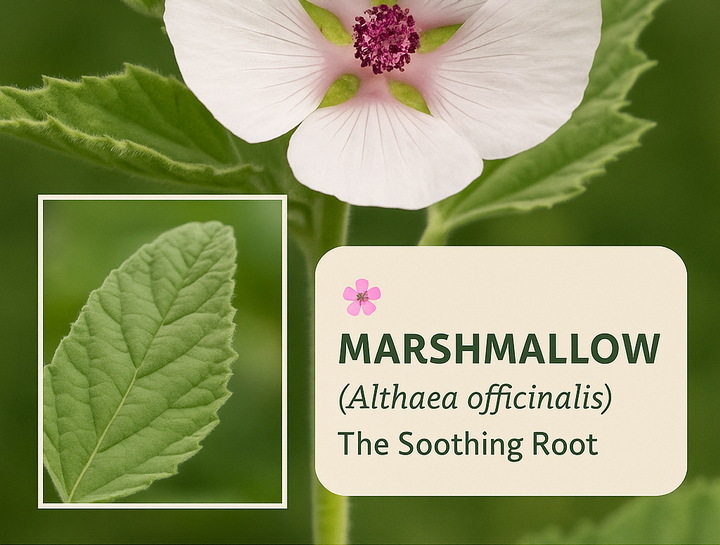
Marshmallow (Althaea officinalis)
Also known as: Common Marshmallow, White Mallow
Family: Malvaceae
Parts used: Roots (sometimes leaves)
Where it grows: Native to Europe, Western Asia, and North Africa. Prefers moist, fertile soils near rivers and wetlands but adapts well to garden cultivation. In USDA Zone 7b, Marshmallow can be perennial, though it’s slow to establish from seed due to its need for cold stratification.
Fun Fact: The original marshmallow confection was made by whipping the mucilaginous sap from Althaea officinalis root with egg whites and sugar — centuries before gelatin replaced it!
Traditional and Modern Uses:
Marshmallow has long been revered as a soothing remedy for irritated tissues — both internally and externally. Traditional herbalists prescribed it for sore throats, digestive inflammation, and urinary tract irritation. In modern veterinary practice, it’s valued as a demulcent and vulnerary, used to coat and protect mucous membranes of the GI and urinary tracts, as well as to soothe inflamed skin and wounds.
How It Works:
The primary active constituent, mucilage, is a complex polysaccharide that forms a slippery, protective layer over irritated tissues. This coating effect reduces inflammation and promotes healing in mucosal surfaces such as the stomach, intestines, throat, and urinary tract. Additional compounds — including flavonoids, tannins, and asparagine — contribute mild anti-inflammatory, diuretic, and nutritive effects. Because mucilage is water-soluble and degraded by heat, cold infusion is the preferred preparation to preserve its demulcent activity.
Safety & Precautions:
Marshmallow is exceptionally safe, even for sensitive patients. There are no known contraindications or adverse effects. However, its mucilage content may slow the absorption of orally administered medications, glucose, or other nutrients if given concurrently. To avoid interference, separate dosing by 1–2 hours.
*Always consult your veterinarian before introducing any herb or supplement.
Research Spotlight:
A 2021 study published in the American Journal of Veterinary Research evaluated the mucoprotective effects of Althaea officinalis extract in dogs with experimentally induced gastritis. The treatment group receiving Marshmallow root extract showed significant reductions in gastric lesion severity and improved mucosal integrity compared to controls. The authors concluded that Marshmallow may serve as an effective adjunct in managing gastrointestinal inflammation.
(Source: Am J Vet Res, 2021 — “Evaluation of Althaea officinalis extract on gastric mucosal healing in dogs.”)
This information is for educational purposes only and is not a substitute for individualized veterinary care. Always consult your veterinarian before giving herbs or supplements to your pet.
© 2025 Zach Lane, DVM — Content used with permission