
Monthly Herbal Monograph - Passionflower
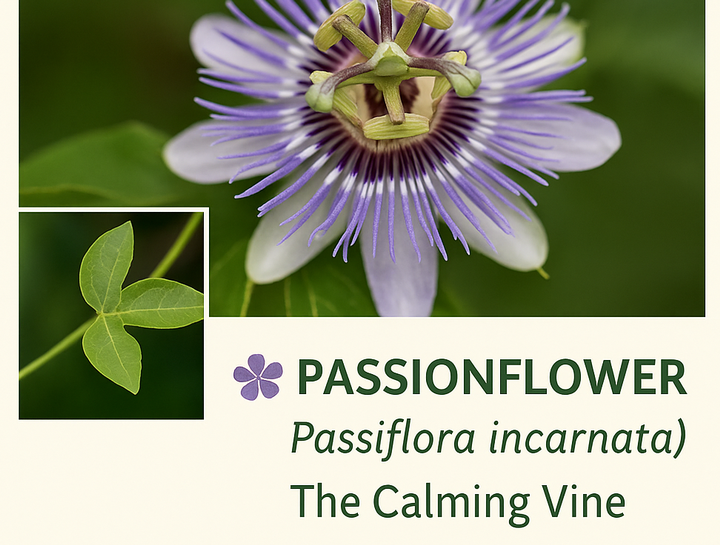
Passionflower (Passiflora incarnata)
Also known as: Maypop, Wild Passion Vine
Family: Passifloraceae
Parts used: Aerial parts (leaves, stems, and flowers)
Where it grows: Native to the southeastern United States, Passionflower thrives in sunny fields, woodland edges, and along fences where its vines can climb. In USDA Zones 6–10, it’s a hardy perennial and an important pollinator plant, producing intricate purple and white blossoms followed by edible fruit.
Fun Fact: The name “Passionflower” was given by early Spanish explorers, who saw in its complex bloom a symbol of Christ’s Passion — the five petals and five sepals representing the ten faithful apostles, and the corona filaments symbolizing the crown of thorns.
Traditional and Modern Uses:
Long valued as a calming nervine, Passionflower has been used by Indigenous peoples of the Americas for anxiety, restlessness, and insomnia. Modern herbalists and veterinarians use it as an anxiolytic, sedative, and antispasmodic—especially in animals experiencing situational stress, travel anxiety, or excitability. It’s also beneficial in patients with concurrent digestive or neurological tension, often used alongside Skullcap or Valerian for synergistic support.
How It Works:
Passionflower’s relaxing effects stem primarily from its flavonoids (including apigenin and vitexin) and alkaloids (such as harman derivatives). These compounds modulate GABA (gamma-aminobutyric acid) pathways in the brain, enhancing inhibitory neurotransmission and promoting calm without strong sedation. The plant also exhibits mild analgesic and antispasmodic properties, making it valuable in cases of stress-induced muscle tension or gastrointestinal cramping.
Safety & Precautions:
Passionflower is exceptionally gentle and well-tolerated. It may have additive effects when combined with sedatives, anxiolytics, or other CNS depressants, so concurrent use should be monitored carefully. No known contraindications or serious adverse effects have been reported.
*Always consult your veterinarian before introducing any herb or supplement.
Research Spotlight:
A 2017 study published in the Journal of Veterinary Behavior investigated the use of Passiflora incarnata extract in dogs with noise anxiety. Dogs receiving the extract showed reduced reactivity to loud sounds and lower cortisol levels compared to placebo. The authors concluded that Passionflower may provide a safe, natural adjunct to behavioral therapy for stress-related canine anxiety.
(Source: J Vet Behav, 2017 — “Evaluation of Passiflora incarnata extract in the management of canine anxiety.”)
This information is for educational purposes only and is not a substitute for individualized veterinary care. Always consult your veterinarian before giving herbs or supplements to your pet.
© 2025 Zach Lane, DVM — Content used with permission